
Send a location via WhatsApp API (sendLocation)
This scenario sends a map location with sendLocation during the 24-hour customer service window.
Use case overview
This scenario sends a map location with sendLocation during the 24-hour customer service window. Coordinates, location name, and address help the buyer navigate without copying text.
Template example
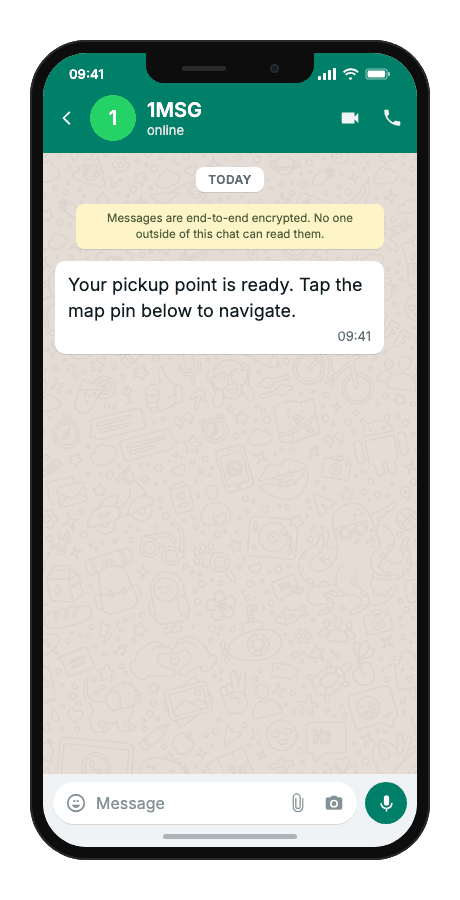
Your pickup point is ready. Tap the map pin below to navigate.
When to use it
Reach for this scenario when an order moves to ready-for-pickup and the buyer still needs the exact collection point while the WhatsApp session is open. It fits click-and-collect ecommerce where typing addresses by hand causes wrong turns and repeat support contacts.
Workflow
- Status tracked
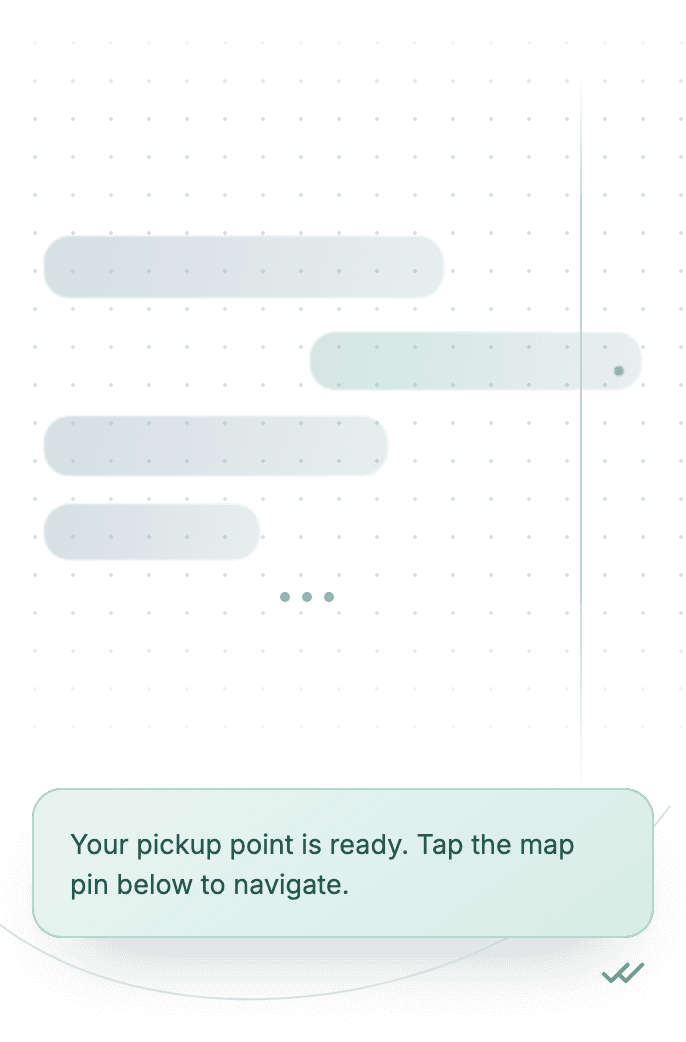
An order status change indicates the parcel is ready for pickup.
status:"read" - Capture event
Your backend loads coordinates, location name, and street address.
phone:"+…" - Build & send
sendLocation delivers the pin to the client in the active session.
POST/send_location - Delivered
The client opens maps navigation from the shared location card.
delivered
Technical implementation
Prerequisites
- 1MSG API Key · How to get API Key
- WhatsApp Business account · How to Connect WABA
- Open 24-hour session window · How the 24-hour window works
- Customer opt-in · How to Manage Customers Consent
- Webhook endpoint · How to Set Up Webhooks
Code examples
#!/usr/bin/env bash
set -euo pipefail

# === Configuration (replace "___" placeholders) ===
API_BASE_URL="https://api.1msg.io"        # production 1MSG API base URL
CHANNEL_ID="___"                           # channel ID from 1MSG dashboard
API_TOKEN="___"                            # channel JWT token (Bearer)


# === Test data ===
TEST_PHONE="___"                 # client phone in international format

PHONE_NORM="$(printf '%s' "$TEST_PHONE" | tr -cd '0-9')"
URL="${API_BASE_URL%/}/${CHANNEL_ID}/sendLocation"

read -r -d '' PAYLOAD <<JSON || true
{
  "phone": "${PHONE_NORM}",
  "lat": "41.40338",
  "lng": "2.17403",
  "name": "Pickup point",
  "address": "Example street 1"
}
JSON

RESPONSE="$(curl -s -w '\n%{http_code}' -X POST "$URL" \
  -H "Content-Type: application/json" \
  -H "Authorization: Bearer ${API_TOKEN}" \
  -d "$PAYLOAD")"

HTTP_CODE="$(printf '%s' "$RESPONSE" | tail -n1)"
BODY="$(printf '%s' "$RESPONSE" | sed '$d')"

case "$BODY" in
  *'"sent":true'*) ok=1 ;;
  *) ok=0 ;;
esac

if [ "$HTTP_CODE" -ge 200 ] && [ "$HTTP_CODE" -lt 300 ] && [ "$ok" -eq 1 ]; then
  echo "Message sent to client."
else
  echo "$BODY" >&2
  exit 1
fi
Response and delivery status
HTTP 2xx and JSON "sent": true mean 1MSG accepted the message for sending — not that it already reached the customer's phone. Save the id field (looks like wamid.…) to correlate delivery callbacks.
{
  "sent": true,
  "message": "Sent to [email protected]",
  "description": "Message has been sent to the provider",
  "id": "wamid.HBgLMzgwNjM5..."
}sentAccepted for sending — not yet on the customer's phone
idStore it; delivery callbacks and
hookInfoare keyed on this
Common errors
| Status | API response | Cause | Fix |
|---|---|---|---|
| 200 | Message was not sent: provide chatId, phone, bsuid, or username | No recipient the channel could resolve. | Pass exactly one recipient: phone (country code plus number, digits only), chatId (for example [email protected]) or bsuid. |
| 401 | token is required | The request has no token. | Add your channel token as the token query parameter: https://api.1msg.io/{channelId}/{method}?token=… |
| 429 | too many requests. please try later | The channel is over its send rate. | Queue messages on your side and retry with exponential backoff. |