
Order confirmation reminder via WhatsApp API
The scenario sends the customer a personalized WhatsApp template when they have not responded to a prior order-related message within the expected time.
Use case overview
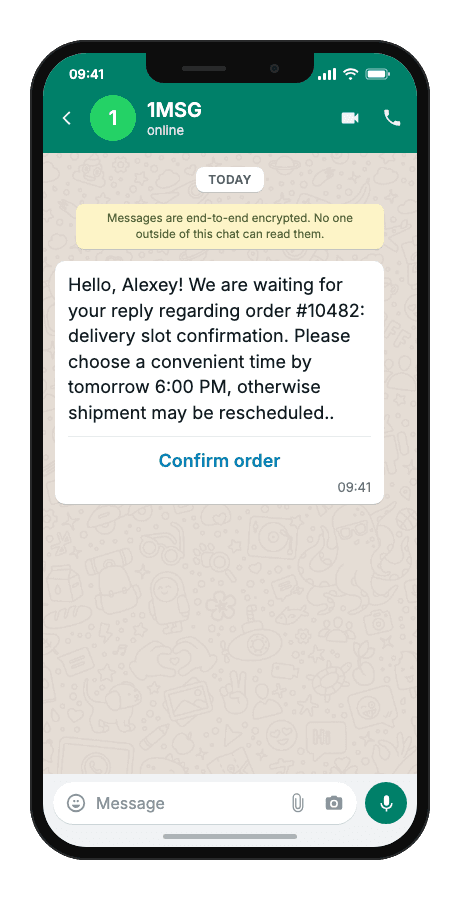
The scenario sends the customer a personalized WhatsApp template when they have not responded to a prior order-related message within the expected time. The message includes the customer name, order number, pending action context, and what to do next. A static URL button opens order confirmation or support.
Template example
Hello, {{1}}! We are waiting for your reply regarding order #{{2}}: {{3}}. {{4}}.
- {{1}}customer name
- {{2}}order number
- {{3}}pending action context (delivery slot, address, pickup time)
- {{4}}reminder instruction or deadline
- “Confirm order”button — fixed in the Meta template
When to use it
Reach for this scenario when a customer received an order-related WhatsApp message — a delivery slot, address confirmation, or pickup time — but did not reply within your SLA, and the order is at risk of stalling in warehouse or carrier queues. It fits e-commerce logistics teams, click-and-collect operations, and integrators wiring order workflow timeout webhooks to WhatsApp.
Workflow
- Trigger
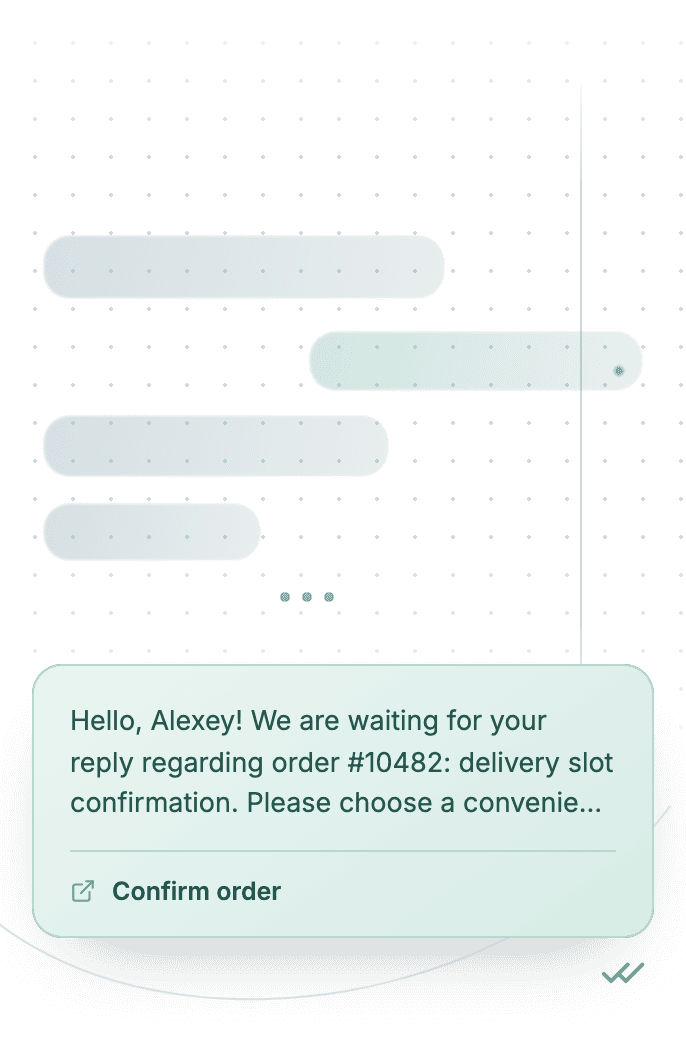
The order workflow detects no customer response within the SLA window.
event·triggered - Capture event
The system resolves the customer phone number and pending action fields.
phone:"+…" - Build & send
A personalized template message is built with four body variables and a static URL button.
POST/sendTemplate - Delivered
The customer receives the WhatsApp reminder and can confirm via the button.
delivered - Status tracked
Delivery result is logged; errors are handled according to platform rules.
status:"read"
Technical implementation
Prerequisites
- 1MSG API Key · How to get API Key
- WhatsApp Business account · How to Connect WABA
- WhatsApp Template · How to Approve WABA Template
- Customer opt-in · How to Manage Customers Consent
Code examples
#!/usr/bin/env bash
set -euo pipefail

# === Configuration (replace "___" placeholders) ===

API_BASE_URL="https://api.1msg.io"        # production 1MSG API base URL
CHANNEL_ID="___"                           # channel ID from 1MSG dashboard
API_TOKEN="___"                            # channel JWT token (Bearer)

TEMPLATE_NAME="___"                        # approved template name
TEMPLATE_NAMESPACE="___"                   # template namespace (required — send fails without it)
TEMPLATE_LANGUAGE="___"                    # template language code, e.g. "en"


# === Test data ===
TEST_PHONE="___"                 # client phone in international format
TEST_CUSTOMERNAME="___"         # {{1}} customer name
TEST_TICKETNUMBER="___"         # {{2}} ticket number
TEST_TOPIC="___"         # {{3}} topic or subject
TEST_NEXTSTEP="___"         # {{4}} next step

PHONE_NORM="$(printf '%s' "$TEST_PHONE" | tr -cd '0-9')"

for pair in "CHANNEL_ID=$CHANNEL_ID" "API_TOKEN=$API_TOKEN" \
            "TEMPLATE_NAME=$TEMPLATE_NAME" "TEMPLATE_NAMESPACE=$TEMPLATE_NAMESPACE" \
            "TEMPLATE_LANGUAGE=$TEMPLATE_LANGUAGE" "TEST_PHONE=$TEST_PHONE" \
            "TEST_CUSTOMERNAME=$TEST_CUSTOMERNAME" \
            "TEST_TICKETNUMBER=$TEST_TICKETNUMBER" \
            "TEST_TOPIC=$TEST_TOPIC" \
            "TEST_NEXTSTEP=$TEST_NEXTSTEP"; do
    val="${pair#*=}"
    if [ -z "$val" ] || [ "$val" = "___" ]; then
        echo "Missing configuration value: ${pair%%=*}" >&2
        exit 1
    fi
done

if [ -z "$PHONE_NORM" ]; then
    echo "Error: phone number has no digits after normalization" >&2
    exit 1
fi

URL="${API_BASE_URL%/}/${CHANNEL_ID}/sendTemplate"

# params carries body ONLY. Button text is fixed in the Meta template — no button param.

# {{1}} customer name → ${TEST_CUSTOMERNAME}
# {{2}} ticket number → ${TEST_TICKETNUMBER}
# {{3}} topic or subject → ${TEST_TOPIC}
# {{4}} next step → ${TEST_NEXTSTEP}
read -r -d '' PAYLOAD <<JSON || true
{
  "phone": "${PHONE_NORM}",
  "template": "${TEMPLATE_NAME}",
  "namespace": "${TEMPLATE_NAMESPACE}",
  "language": { "policy": "deterministic", "code": "${TEMPLATE_LANGUAGE}" },
  "params": [
    {
      "type": "body",
      "parameters": [
        { "type": "text", "text": "${TEST_CUSTOMERNAME}" },
        { "type": "text", "text": "${TEST_TICKETNUMBER}" },
        { "type": "text", "text": "${TEST_TOPIC}" },
        { "type": "text", "text": "${TEST_NEXTSTEP}" }
      ]
    }

  ]
}
JSON

RESPONSE="$(curl -s -w '\n%{http_code}' -X POST "$URL" \
    -H "Content-Type: application/json" \
    -H "Authorization: Bearer ${API_TOKEN}" \
    -d "$PAYLOAD")"

HTTP_CODE="$(printf '%s' "$RESPONSE" | tail -n1)"
BODY="$(printf '%s' "$RESPONSE" | sed '$d')"

case "$BODY" in
    *'"sent":true'*) ok=1 ;;
    *) ok=0 ;;
esac

if [ "$HTTP_CODE" -ge 200 ] && [ "$HTTP_CODE" -lt 300 ] && [ "$ok" -eq 1 ]; then
    echo "Message sent to client."
    echo "API response: $BODY"
else
    echo "Send failed. HTTP status: $HTTP_CODE" >&2
    echo "$BODY" >&2
    exit 1
fi
Response and delivery status
HTTP 2xx and JSON "sent": true mean 1MSG accepted the message for sending — not that it already reached the customer's phone. Save the id field (looks like wamid.…) to correlate delivery callbacks.
{
  "sent": true,
  "message": "Sent to [email protected]",
  "description": "Message has been sent to the provider",
  "id": "wamid.HBgLMzgwNjM5..."
}sentAccepted for sending — not yet on the customer's phone
idStore it; delivery callbacks and
hookInfoare keyed on this
Common errors
| Status | API response | Cause | Fix |
|---|---|---|---|
| 200 | Message was not sent: template is not defined | namespace, template or language is missing from the request body. | Send all three. Take namespace and the exact template name from GET /templates; language is an object: {"policy": "deterministic", "code": "en"}. |
| 200 | template name (…) does not exist in <language> | The template is approved in a different language than the one requested. | Use the exact language code the template was approved in (for example es_MX is not the same as es). Check it in GET /templates. |
| 200 | Message was not sent: provide chatId, phone, bsuid, or username | No recipient the channel could resolve. | Pass exactly one recipient: phone (country code plus number, digits only), chatId (for example [email protected]) or bsuid. |